 Close
Close


Our ability to explore fundamental physics of new opto-electronic devices through to high-speed optical systems research is a particular strength, and unique among UK universities.
Overview
The Photonics Group is involved in studies of opto-electronic devices, sub-systems and systems ranging from semiconductor lasers and liquid crystal devices to imaging, THz over fibre broadband access systems and software controlled optical communications systems, with close interactions with industry and other leading research groups around the world.
Our ability to explore fundamental physics of new opto-electronic devices through to high-speed optical systems research is a particular strength, and unique among UK universities. The Group's announced new grant and contract income over the period 2014 to 2019 is over £ 20 million and is on a rising trend.
In work on Molecular Beam Epitaxy (MBE), we were the first group to demonstrate practical telecommunications wavelength lasers monolithically integrated on silicon substrates and have made numerous contributions to nanowire and quantum dot technology.
In work on ultra-fast photonics we have played a leading part in wireless over fibre broadband access research, optical frequency synthesis and novel InP based laser, modulator and regenerator device design and fabrication. In work on optical devices and systems we have developed low cost, high capacity, short range transmission systems and are active in 2d optics and advanced liquid crystal device research.
Our basic opto-electronics research activities are important to the future growth of the Group and of major importance in their own right. Our work on time-resolved non-linear optical absorption in quantum well devices has led to a range of ultra-fast optical processing devices. Novel 2d optics research includes multimode polymer waveguide backplane connector modelling and the application of liquid crystals to microwave systems.
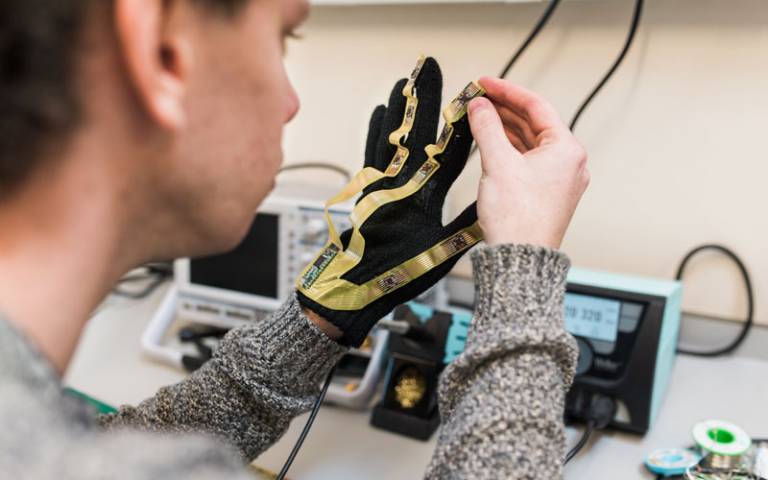
A PhD student from the Photonics group exploring motion capturing technology.
People
Research Themes
- Molecular Beam Epitaxy (MBE)
UCL MBE Research group is led by Prof Huiyun Liu, who joined UCL in 2007. As part of the Photonics Group at Department of Electronic and Electrical Engineering, MBE group focuses on semiconductor photonic and optoelectronic devices and materials. Further details can be found on the MBE group page.
- Optical Devices & Systems
Our research includes the mathematical design, computer modelling, clean room fabrication, experimental measurement and analysis of optical interconnections, devices and systems. Further details can be found on the Optical Devices & Systems group page.
- Ultra-fast Photonics
Our research is devoted to photonic devices and systems that work at high speeds. Further details can be found on the Ultra-fast Photonics page.
Research Projects
- New EPSRC HyperTerahertz Programme Grant
Professor Alwyn Seeds, Head of UCL Photonics Group is the UCL PI on a new £6.38m EPSRC Programme Grant called 'HyperTerahertz' (High precision terahertz spectroscopy and microscopy) lead by the University of Leeds. UCL will share £2.6m of the research funding.
This new Programme Grant will build on the highly successful work of the Coherent THz Systems programme grant (COTS) which was lead by Professor Seeds: www.terahertzsystems.org from 2012 to July 2017. COTS demonstrated coherent continuous wave terahertz (THz) systems across the THz spectrum for the first time. The research challenge was stated as follows: "Our vision is to open up the THz spectrum for widespread scientific and commercial application, through the use of photonics-enabled coherent techniques". This was to be achieved by developing heterodyne approaches using telecommunications wavelength laser sources at frequencies below 2 THz, where high performance quantum cascade lasers (QCLs) are difficult to realise, and by the locking of QCLs to achieve controllable highly coherent sources at higher frequencies. This ambitious research challenge has now substantially been achieved.
A video aimed at explaining the importance of the relatively unexplored terahertz (THz) region of the electromagnetic spectrum funded by the UK's EPSRC (EP/J017671/1) is available below:YouTube Widget Placeholderhttps://www.youtube.com/watch?v=7FY5kbvBbic Further details can also be found at:
- EU 'Beyond 5G' TERAPOD project with Dr Cyril Renaud
THz communications wireless links, a disruptive technology for data centres.
TECHNOLOGY experts from academia and industry across Europe are pooling their knowledge and expertise in a ground-breaking, industry-focused and EU-funded project to plot, plan and prepare for the future of wireless technology way beyond 5G.
Waterford Institute of Technology’s world-renowned Telecommunications, Software and Systems Group (TSSG) is the venue today for the first face to face meeting of the Europe-wide team charged with delivering the mammoth 3 year, €3 million plus TERAPOD progamme and ensuring that Europe remains to the fore in such global technological advances.
TERAPOD sees academics and industry leaders from Ireland, the UK, Spain, Portugal and Germany not just investigate but also test and demonstrate the feasibility of an ultra-high bandwidth wireless access networks operating in the Terahertz (THz) band. The band is seen as the new frontier for wireless communication across the globe and the key to satisfying the increasing demand for higher speed wireless communication.
TERAPOD will de-risk THz device and system development. It will disrupt how current Data Centres operate by introducing THz communication wireless links. Data Centres provide the team with an “early adopter” scenario where they will prove the technology and test its impact there.
The tech will move to other use cases also - such as ultrahigh quality video broadcasting, wireless virtual reality and bulk data transfer at Terabits per second. This will dramatically impact on the operational efficiency and geometric design of Data Centres all over the world well into the future, the project team says.
TERAPOD will also progress THz communication as a science and will lead to an exponential growth in scientific output and disclosure of THz communication research over the next 10 years. TERAPOD will also help the THz industry right across the globe to grow dramatically over the next 10 years.
TSSG are project co-ordinators and leading the EU-backed initiative and partnering with Dell EMC means they can test their findings in both the TSSG’s own and Dell EMC’s extensive data centre networks, TSSG’s Dr. Alan Davy said. Their partners include the University of Glasgow and UCL, the National Physical Laboratory (NPL) and Bay Phonics in the UK. German partners include TU Braunschweig, Vivid Components and ACST. The sole Spanish partner is VLC Photonics and the multinational team also includes Inesc Tec from Portugal.
UCL’s Dr Cyril Renaud said: “UCL we have worked in millimetre wave and THz communication technologies for more than 10 years, and have participated in the development of the technology as one of the arguably leading contender for wireless high data rate links. However, so far, no real test of THz system within an application setting have been done to fully assess performances from devices to full network design. This is where I believe TERAPOD is hugely exciting and at the forefront of the research work in the field internationally as it brings experts from each layers of a communication systems and will aim at improving every element of that network from devices to architecture.”
“The European Commission funded 6 projects to look beyond 5G and this flagship initiative is unrivalled. We will focus on concept deployment demonstration within a data centre. The project will bring THz communication a leap closer to industry uptake through leveraging recent advances in THz components, coupled with higher layer communication protocol specification. The saturation of wireless spectrum access is leading to innovations in areas such as spectrum resource usage. It is widely thought however that the low hanging fruits of innovation for wireless communication are all but exploited with only marginal gains possible. For a real step change towards the coveted 1Tbps wireless transmission, new areas of the spectrum must be used. That is what our TERAPOD project is all about,” Dr. Davy explained.
Donagh Buckley, Senior Director, Dell EMC Research Europe, said: “Dell EMC is very excited to be a part of TERAPOD and we look forward to achieving significant technology advances to accelerate our R&D efforts in the Data Centre through this collaboration with Dr. Alan Davy and the project team. Innovation is the life blood of Dell EMC and our external research investment enables us to explore emergent technologies and engage with leading researchers.”
A European Commission spokesperson said the EU and the European Commission support the TERAPOD ambition to exploit frequencies above 90 GHz as a potential solution to the saturation of wireless spectrum access in Europe. “We welcome its objectives of assessing the feasibility of ultrahigh bandwidth access networks and of exploring the elaboration of a technology roadmap for THz communication beyond 5G.”
The project will build a Terahertz based Ultra High Bandwidth Wireless Access Network (TERAPOD). A TERAPOD cell is a very small cell of coverage approximately 10 meters, making it comparable in coverage to a femtocell. However, it could potentially deliver several orders of magnitude higher throughput (x103). This will be demonstrated in a particular use case scenario of wireless network access in Data Centers.
Data centers are ideal first adopter candidates, the partners say, as they provide controllable environmental conditions, which can be favorable for THz wave propagation such as a low moisture atmosphere, limited mobility and limited dynamic channel activity. However simulation and modeling of other deployment settings will also be carried out such as homes, offices and factories.
THz system component development for the purpose of imaging using techniques such as time domain spectroscopy (TDS) has come a long way over the last 10 - 15 years or so. However little has progressed beyond the development of devices to deliver a cost-effective THz communication system leveraging these components, he says. With the help of focused, industry-specific Horizon 2020, European Commission funding, this problem is now being addressed.
The technical objectives of TERAPOD are to evaluate and assess the feasibility of both lab-based and commercial THz components for use within a THz-based communication system. The partners will survey, select, measure and test the system. The EU-wide team will also simulate, demonstrate and evaluate THz communication feasibility of up to 100Gbps within a Data Centre setting as well as other relevant settings.
The European team will also spec and evaluate a THz based Ultra High Bandwidth Access Network and address potential barriers to adoption such as standardization and regulation. They will also be raising awareness and suggesting outreach of THz communication impacts such as workshops, tutorials, training, public engagement and more.
By the end of the 3 year project, the partners aim to practically demonstration and validated a cost-effective THz Communication system within a Data Centre setting and to have developed an early specification of a THz-based High Bandwidth Access Network Architecture and protocols.
Recent advances in THz communication focus in general around the realization of THz transceiver components (emitters and detectors) and THz sources. The EU funded iBROW project has recently demonstrated that Resonance Tunneling Diodes (RTDs) can be feasible transmitters at 300GHz. The project focuses on developing energy efficient THz transceiver technology with seamless interfacing to optical fiber networks using RTDs.
The German national-funded TERAPAN project wishes to demonstrate THz communication of data rates up to 10M in indoor environments using cost-efficient monolithically integrated transceivers. The project focuses on simulation of channel conditions to determine the feasibility of 100 Gbps throughout using high-gain antennas in conjunction with electrical beam forming.
The EPSRC-funded Coherent Terahertz Systems (COTS) programme aims to innovate in three main areas: ultra-broadband wireless communications systems; information processing and thirdly, coherent imaging and sensing.
Further details can also be found on the TERAPOD project website
- The National Dark Fibre Infrastructure Service (NDFIS)
An EPSRC National Research Facility established in 2014 to enable researchers to develop the underpinning communications technologies for the future internet. Visit the NDFIS website for more information.
Details of the grant can be found on the EPSRC website.
- The Photonics Sampling Project
Details of the grant can be found on the EPSRC website.
- Converged Optical and Wireless Access Networks (COALESCE)
Details of the grant can be found on the EPSRC website.
Facilities
Experimental facilities include two Veeco molecular beam epitaxy systems, with a third to be installed in 2020, for the growth of advanced structures on silicon and compound semiconductor substrates, housed in a new purpose built clean room, comprehensive device processing capabilities including direct-write e-beam lithography through our participation in the London Centre for Nanotechnology, and a wide range of characterisation equipment including photo-luminescence spectroscopy, X-Ray diffraction, optical spectrum analysis, network and spectrum analysis to 300 GHz, vector signal analysis and bit error rate measurement.
Visit The Future Compound Semiconductor Manufacturing Hub website for more information.
The Group has strong involvement in two UKRI-EPSRC National Research Facilities. It operates the EPSRC National Dark Fibre Facility (NDFF), in a collaboration with the Universities of Bristol, Cambridge and Southampton. This comprises an installed dark fibre network of some 650km, together with optical switching and Layer 2 interconnects, all under software control.
The Group is also a partner in the EPSRC National Epitaxy Facility with the Universities of Cambridge and Sheffield.
Collaboration
The Photonics Group has extensive collaborative links with many other universities and industry worldwide and provides consultancy services to many companies and other organisations.
In the first instance, please direct consultancy enquiries to the member of academic staff covering the research area of interest.
The Group is also a partner in the EPSRC Future Compound Semiconductor Manufacturing Hub, led by Cardiff University, with the Universities of Manchester and Sheffield.
Spin-out companies from the Group include, Zinwave. Founded in 2003 from the Department of Electronic and Electrical Engineering in collaboration with the University of Cambridge, Zinwave aims to provide sub-systems and systems for distributing wireless signals, including those for applications such as cellular radio and WLAN in a flexible, future proof and low cost manner. Zinwave’s proprietary technology enables these applications to be serviced using low cost multi-mode fibres, giving rise to significant cost savings for system providers and installers. Further information can be found at Zinwave