Mick Flanagan's research is centred on the examination of the role of the Meyer and Land pedagogic Threshold Concept in the teaching of electrical engineering at the undergaduate level, teaching programming languages to electrical engineering students and in the development of technology-enhanced learning (TEL) environments for continual professional development.
This research involves collaborations with Professor J H F Meyer, Professor of Education, Faculty of Engineering, Architecture and Information Technology, University of Queensland, on several aspects of teaching across engineering and related sciences and with Dr Jan Smith, Centre for Academic Practice, School of Edcation, Durham University, on the teaching of programming languages.
Mick Flanagan also is or has been a collaborator in:
- The Royal Academy of Engineering / National HE STEM Programme Project, Uncovering threshold values in first year engineering courses and implications for curriculum design
Collaborators: Artemis Stamboulis (University of Birmingham), Caroline Baillie (Open University) and Mick Flanagan (UCL).
- The Royal Academy of Engineering / National HE STEM Programme Project, Engineering thresholds in engineering curriculum review
Collaborators: Artemis Stamboulis (University of Birmingham), Mick Flanagan (UCL) and Caroline Baillie (Open University).
- Birmingham University Centre for Learning and Academic Development (CLAD) Project, Threshold concept framework in engineering curriculum review and design and implicvation in enquiry based learning
Principlal investigator: Artemis Stamboulis (University of Birmingham).
- The European Commission Seventh Framework Information and Communication Technologies Digital Libraries Project TARGET (Transformative, Adaptive, Responsive and enGaging EnvironmenT). The main objective of TARGET is the development of a virtual world serious game that will support rapid competence development in project management and project innovation. Threshold Concepts studies centred on project and innovation management conducted both within undergraduate and postgraduate courses of the academic partners and within the training departments of the industrial partners will inform the development of serious game scenarios.
Mick Flanagan was an overseas member of the reference panel for the Australian Learning and Teaching Council (ALTC) Project, Engineering thresholds: an approach to curriculum renewal, based at the University of Western Australia, Perth.
See The Threshold Concept and Undergraduate Teaching for a brief introduction to pedagogic threshold concepts.
|
Presentations and publications on the threshold concept
-
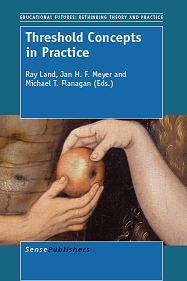
Threshold Concepts in Practice (2016)
Edited by Ray Land, Jan H. F. Meyer and Michael T Flanagan
Sense Publishers, Rotterdam/Boston/Taipei, 2016
ISBN: 978-94-6300-510-4 (paperback), ISBN: 978-94-6300-511-1 (hardback), ISBN: 978-94-6300-512-8 (e-book)
[Educational Futures: Rethinking Theory and Practice, Michael A Peters (Ed.), volume 68]
Threshold Concepts in Practice brings together fifty researchers from sixteen countries and a wide variety of disciplines to analyse their teaching practice, and the learning experiences of their students, through the lens of the Threshold Concepts Framework.
Book Details.
|
|
-
Flanagan, M.T., Ackermann, G., Zimmermann, M, Hokstad, L.M. Andersen, B. and Fradinho, M. (2014) A comparative academic/industrial professional development study in project management
in Threshold Concepts: From Personal Practice to Communities of Practice, Proceedings of the National Academy's Sixth Annual Conference and the Fourth Biennial Threshold Concepts Conference [e-publication], Editors: Catherine O'Mahony, Avril Buchanan, Mary O'Rourke and Bettie Higgs, January 2014, NAIRTL, Ireland, ISBN: 978-1-906642-59-4, pp 133-137.
Full paper: http://www.nairtl.ie/documents/EPub_2012Proceedings.pdf#page=143
-
On Epistemes
Meyer, J.H.F. and Flanagan, M.T.
Featured Invited Lecture given at the Third Biennial Threshold Concepts Symposium: Exploring transformative dimensions of threshold concepts, The University of New South Wales and the University of Sydney, Sydney, Australia, 1-2 July 2010.
Video of the lecture: http://tv.unsw.edu.au/video/professor-erik-meyer-and-dr-mick-flanagan
-
Transformational Learning and Serious Game Design
Flanagan, M.T., Hokstad, L., Zimmerman, M., Ackermann, G., Fradinho, M. and Andersen, B.
Paper presented at the Third Biennial Threshold Concepts Symposium: Exploring transformative dimensions of threshold concepts, The University of New South Wales and the University of Sydney, Sydney, Australia, 1-2 July 2010.
-
Rapid Competence Development in Serious Games using Case-Based Reasoning and Threshold Concepts
Hulpus,I., Fradinho, M., Hayes, C., Hokstad, L., Seager, W. and Flanagan, M.
Paper presented at the 2nd International Conference on Computer Supported Education (CSEDU 2010), Valencia, Spain, 7-10 April 2010.
-
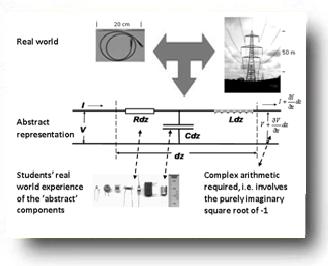
Compounded Thresholds in Electrical Engineering
Flanagan, M. T., Taylor, P. and Meyer, J.H.F.
In 'Threshold Concepts and Transformational Learning' Meyer, J.H.F., Land, R., and Baillie, C., (eds), Sense Publishers, Rotterdam, 227−239 (2010)
[Educational Futures: Rethinking Theory and Practice, Volume 42]
-
Some current perspectives on threshold concepts
Introductory Workshop led by
Flanagan, M.T. and Meyer, J.H.F.
at Improving Student Learning - For the 21st Century Learner, The 17th Improving Student Learning Symposium, Imperial College London, UK, 7-9 September 2009.
- The Threshold Concept
J H F Meyer and M T Flanagan
A workshop presented at
National Acadamy for the Integration of Research and Teaching and Learning (NAIRTL) 2nd Annual Conference - Teaching and Learning in Higher Education: Challenging Assumptions, Waterford Institute of Technology, Waterford, Ireland, 13th - 14th November 2008
- Compounded Thresholds in Electrical Engineering
M T Flanagan, P Taylor and J H F Meyer
Presented at the Threshold Concepts Conference: from theory to practice
Queen's University, Kingston, Ontario, Canada, 18th - 20th June 2008
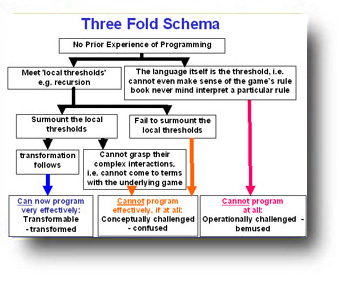
- From playing to understanding: the transformative potential of discourse versus syntax in learning to program
Flanagan, M. T. and Smith, J.
In 'Threshold Concepts within the Disciplines', Land, R., Meyer, J.H.F. and Smith, J., (eds), Sense Publishers, Rotterdam, pp 91-104, (2008), [Educational Futures: Rethinking Theory and Practice, Peters, M.A & Freeman-Moir, J. (Eds), volume 16] ISBN 978-90-8790-267-4 (paperback), ISBN 978-90-8790-268-1 (hardback)
-
The Threshold Concept in Electrical Engineering
M T Flanagan
Presented at
6th Annual American Society for Engineering Education (ASEE) Global Colloquium on Engineering Education
Boğaziçi University, Istanbul, Turkey, 1-4 October, 2007.
-
Thresholds, interdisciplinarity and enculturation across the engineering and science disciplines
M T Flanagan and J H F Meyer
Proceedings of the 2007 15th International Symposium Improving Student Learning − For What?, Trinity College, Dublin, Ireland, 3−5 September 2007, Rust, C. (Ed), OCSLD, Oxford (2008), vol 15, pp 48-58.
-
Some thoughts on threshold concepts in electronic and electrical engineering:
Reactive Power, Characteristic Impedance and Resonance?
M T Flanagan
1st Durham Threshold Concepts Symposium (Science and Engineering)
University of Durham, 19 February 2007
- Threshold concepts: troublesome topographies for the Google generation
M T Flanagan and J Smith
Presented at Beyond Boundaries: New Horizons for Research into Higher Education
Annual Conference of the Society for Research into Higher Education
Brighton: 12 - 14 December 2006
- From playing to understanding: the transformative potential of discourse versus syntax in learning to program
M T Flanagan and J Smith
Threshold Concepts within the Disciplines Symposium
University of Strathclyde, Glasgow, UK, 30 August−1 September 2006
Abstract of the presentation
|
|


 +44 (0)20 7679 7306 - Copyright © UCL 1999–2013