Michael Thomas Flanagan's Java Scientific Library

ProbabilityPlot Class:     Probablity Plots


Last update: 4 January 2012                                                                                                                              PERMISSION TO COPY
Main Page of Michael Thomas Flanagan's Java Scientific Library

This class contains methods for plotting probability plots. It contains methods for
Presently pobability plot methods are available for the:
               
Reference:
NIST/SEMATECH Engineering Statistics Handbook: 1.3.3.22. Probability Plot, http://www.itl.nist.gov/div898/handbook/eda/section3/probplot.htm

Warning: The errors of the estimated distribution parameters, e.g. μ and of σ for a Gaussian distribution, are estimated using linear statistical procedures assuming that these non-linear functions behave in a linear manner about the optimization minimum of the sum of squares of the data minus the corresponding order statistic median. The relevant Hessian matrix is calculated numerically. These error values should be treated with great caution. They are, at best, an indication of the minimum value that the error may take and in most cases probably significantly underestimate the true error.
The errors reported for the probabilty plot gradient and intercept are obtained fro a linear regression and are reliable.

See
Regression class for alternative regression procedures.
See Stat class for the general statistical methods and functions.

import directive: import flanagan.analysis.ProbabilityPlot;

SUMMARY OF METHODS

Constructors   public ProbabilityPlot(double[] dataArray)
public ProbabilityPlot(Double[] dataArray)
public ProbabilityPlot(float[] dataArray)
public ProbabilityPlot(Float[] dataArray)
public ProbabilityPlot(int[] dataArray)
public ProbabilityPlot(Integer[] dataArray)
public ProbabilityPlot(long[] dataArray)
public ProbabilityPlot(Long[] dataArray)
public ProbabilityPlot(short[] dataArray)
public ProbabilityPlot(Short[] dataArray)
public ProbabilityPlot(byte[] dataArray)
public ProbabilityPlot(Byte[] dataArray)
public ProbabilityPlot(BigDecimal[] dataArray)
public ProbabilityPlot(BigInteger[] dataArray)
public ProbabilityPlot(ArrayMaths dataArray)
public ProbabilityPlot(ArrayList<Object> dataArray)
public ProbabilityPlot(Vector<Object> dataArray)
public ProbabilityPlot(Stat dataArray)
Supress display of the plot Supress display public void supressDisplay()
Restore display public void restoreDisplay()
Gaussian Probability Plot
(Normal Probability Plot)

See below for the
Standard Gaussian Probability Plot
Calculate and display plot public void gaussianProbabiltyPlot()
Correlation coefficient public double gaussianCorrelationCoefficient()
Gradient value public double gaussianGradient()
error public double gaussianGradientError()
Intercept value public double gaussianIntercept()
error public double gaussianInterceptError()
μ value public double gaussianMu()
error public double gaussianMuError()
σ value public double gaussianSigma()
error public double gaussianSigmaError()
Sum of squares public double gaussianSumOfSquares()
Order Statistic Medians public double[] gaussianOrderStatisticMedians()
Standard Gaussian Probability Plot
(Normal Probability Plot)

See above for the
Two Parameter Gaussian Probability Plot
Calculate and display plot public void gaussianStandardProbabiltyPlot()
Correlation coefficient public double gaussianStandardCorrelationCoefficient()
Gradient value public double gaussianStandardGradient()
error public double gaussianStandardGradientError()
Intercept value public double gaussianStandardIntercept()
error public double gaussianStandardInterceptError()
Sum of squares public double gaussianStandardSumOfSquares()
Order Statistic Medians public double[] gaussianStandardOrderStatisticMedians()
Exponential Probability Plot Calculate and display plot public void exponentialProbabiltyPlot()
Correlation coefficient public double exponentialCorrelationCoefficient()
Gradient value public double exponentialGradient()
error public double exponentialGradientError()
Intercept value public double exponentialIntercept()
error public double exponentialInterceptError()
μ value public double exponentialMu()
error public double exponentialMuError()
σ value public double exponentialSigma()
error public double exponentialSigmaError()
Sum of squares public double exponentialSumOfSquares()
Order Statistic Medians public double[] exponentialOrderStatisticMedians()
F-Distribution Probability Plot Calculate and display plot public void fDistributionProbabiltyPlot(int nu1, int nu2)
Correlation coefficient public double fDistributionCorrelationCoefficient()
Gradient value public double fDistributionGradient()
error public double fDistributionGradientError()
Intercept value public double fDistributionIntercept()
error public double fDistributionInterceptError()
Sum of squares public double fDistributionSumOfSquares()
Order Statistic Medians public double[] fDistributionOrderStatisticMedians()
Fréchet Probability Plot Calculate and display plot public void frechetProbabiltyPlot()
Correlation coefficient public double frechetCorrelationCoefficient()
Gradient value public double frechetGradient()
error public double frechetGradientError()
Intercept value public double frechetIntercept()
error public double frechetInterceptError()
μ value public double frechetMu()
error public double frechetMuError()
σ value public double frechetSigma()
error public double frechetSigmaError()
γ value public double frechetGamma()
error public double frechetGammaError()
Sum of squares public double frechetSumOfSquares()
Order Statistic Medians public double[] frechetOrderStatisticMedians()
Gumbel (minimum order statistic) Probability Plot Calculate and display plot public void gumbelMinProbabiltyPlot()
Correlation coefficient public double gumbelMinCorrelationCoefficient()
Gradient value public double gumbelMinGradient()
error public double gumbelMinGradientError()
Intercept value public double gumbelMinIntercept()
error public double gumbelMinInterceptError()
μ value public double gumbelMinMu()
error public double gumbelMinMuError()
σ value public double gumbelMinSigma()
error public double gumbelMinSigmaError()
Sum of squares public double gumbelMinSumOfSquares()
Order Statistic Medians public double[] gumbelMinOrderStatisticMedians()
Gumbel (maximum order statistic) Probability Plot Calculate and display plot public void gumbelMaxProbabiltyPlot()
Correlation coefficient public double gumbelMaxCorrelationCoefficient()
Gradient value public double gumbelMaxGradient()
error public double gumbelMaxGradientError()
Intercept value public double gumbelMaxIntercept()
error public double gumbelMaxInterceptError()
μ value public double gumbelMaxMu()
error public double gumbelMaxMuError()
σ value public double gumbelMaxSigma()
error public double gumbelMaxSigmaError()
Sum of squares public double gumbelMaxSumOfSquares()
Order Statistic Medians public double[] gumbelMaxOrderStatisticMedians()
Logistic Probability Plot Calculate and display plot public void logisticProbabiltyPlot()
Correlation coefficient public double logisticCorrelationCoefficient()
Gradient value public double logisticGradient()
error public double logisticGradientError()
Intercept value public double logisticIntercept()
error public double logisticInterceptError()
μ value public double logisticMu()
error public double logisticMuError()
β value public double logisticBeta()
error public double logisticBetaError()
Sum of squares public double logisticSumOfSquares()
Order Statistic Medians public double[] logisticOrderStatisticMedians()
Pareto Probability Plot Calculate and display plot public void paretoProbabiltyPlot()
Correlation coefficient public double paretoCorrelationCoefficient()
Gradient value public double paretoGradient()
error public double paretoGradientError()
Intercept value public double paretoIntercept()
error public double paretoInterceptError()
α value public double paretoAlpha()
error public double paretoAlphaError()
β value public double paretoBeta()
error public double paretoBetaError()
Sum of squares public double paretoSumOfSquares()
Order Statistic Medians public double[] paretoOrderStatisticMedians()
Rayleigh Probability Plot Calculate and display plot public void rayleighProbabiltyPlot()
Correlation coefficient public double rayleighCorrelationCoefficient()
Gradient value public double rayleighGradient()
error public double rayleighGradientError()
Intercept value public double rayleighIntercept()
error public double rayleighInterceptError()
β value public double rayleighBeta()
error public double rayleighBetaError()
Sum of squares public double rayleighSumOfSquares()
Order Statistic Medians public double[] rayleighOrderStatisticMedians()
Weibull Probability Plot
(Three Parameters)

See below for the Two Parameter Weibull and
the Standard Weibull Probability Plots
Calculate and display plot public void weibullProbabiltyPlot()
Correlation coefficient public double weibullCorrelationCoefficient()
Gradient value public double weibullGradient()
error public double weibullGradientError()
Intercept value public double weibullIntercept()
error public double weibullInterceptError()
μ value public double weibullMu()
error public double weibullMuError()
σ value public double weibullSigma()
error public double weibullSigmaError()
γ value public double weibullGamma()
error public double weibullGammaError()
Sum of squares public double weibullSumOfSquares()
Order Statistic Medians public double[] weibullOrderStatisticMedians()
Two parameter Weibull Probability Plot

See above for Three Parameter Weibull Plot
See below for Standard Weibull Plot
Calculate and display plot public void weibullTwoParProbabiltyPlot()
Correlation coefficient public double weibullTwoParCorrelationCoefficient()
Gradient value public double weibullTwoParGradient()
error public double weibullTwoParGradientError()
Intercept value public double weibullTwoParIntercept()
error public double weibullTwoParInterceptError()
σ value public double weibullTwoParSigma()
error public double weibullTwoParSigmaError()
γ value public double weibullTwoParGamma()
error public double weibullTwoParGammaError()
Sum of squares public double weibullTwoParSumOfSquares()
Order Statistic Medians public double[] weibullTwoParOrderStatisticMedians()
Standard Weibull Probability Plot

See above for Three Parameter Weibull and
Two Parameter Weibull Probability Plots
Calculate and display plot public void weibullStandardProbabiltyPlot()
Correlation coefficient public double weibullStandardCorrelationCoefficient()
Gradient value public double weibullStandardGradient()
error public double weibullStandardGradientError()
Intercept value public double weibullStandardIntercept()
error public double weibullStandardInterceptError()
γ value public double weibullStandardGamma()
error public double weibullStandardGammaError()
Sum of squares public double weibullStandardSumOfSquares()
Order Statistic Medians public double[] weibullStandardOrderStatisticMedians()
Common methods Ordered data array public double[] orderedData()
Number of data points public int numberOfDataPoints()
Data mean public double mean()
Data standard deviation public double standardDeviation()
Data minimum public double minimum()
Data maximum public double maximum()
Numerical differentiation
step, &delta
Current value public double delta()
Reset value public void resetDelta(double delta)
Standard deviation
denominator
Set to n public void setDenominatorToN()
Set to n-1 public void setDenominatorToNminusOne()


CONSTRUCTORS

public ProbabilityPlot(double[] dataArray)
public ProbabilityPlot(Double[] dataArray)
public ProbabilityPlot(float[] dataArray)
public ProbabilityPlot(Float[] dataArray)
public ProbabilityPlot(int[] dataArray)
public ProbabilityPlot(Integer[] dataArray)
public ProbabilityPlot(long[] dataArray)
public ProbabilityPlot(Long[] dataArray)
public ProbabilityPlot(short[] dataArray)
public ProbabilityPlot(Short[] dataArray)
public ProbabilityPlot(byte[] dataArray)
public ProbabilityPlot(Byte[] dataArray)
public ProbabilityPlot(BigDecimal[] dataArray)
public ProbabilityPlot(BigInteger[] dataArray)
public ProbabilityPlot(ArrayMaths dataArray)
public ProbabilityPlot(ArrayList<Object> dataArray)
public ProbabilityPlot(Vector<Object> dataArray)
public ProbabilityPlot(Stat dataArray)
Usage:                      ProbabilityPlot pp = new ProbabilityPlot(dataArray);
Creates an instance of ProbabilityPlot. The data array is stored as a one dimensional array of double but may be entered as:


SUPRESS AND RESTORE A DISPLAY OF THE PLOT

Supress the display of the calculated probability plot
public void supressDisplay()
Usage:                      pp.supressDisplay();
The primary probability plot methods listed below, e.g. gauassianProbabilityPlot(), both calculate and display the relevant probability plot. This method supresses the latter display of the plot but leaves the calculation of the plot parameters intact.

Restore the display of the calculated probability plot
public void restoreDisplay()
Usage:                      pp.restoreDisplay();
This method restores the display of the calculated probability plots.


GAUSSIAN PROBABILITY PLOTS (NORMAL PROBABILITY PLOTS)

TWO PARAMETER GAUSSIAN PROBABILITY PLOT
See below for the Standard Gaussian Probability Plot

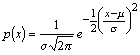
This section describes methods for plotting and analysising Gaussian Probability Plots where the Gaussian probabilty density function is defined as

Naming note: gaussian may be replaced by normal in the names of all these methods, e.g. normalProbabilityPlot() performs the same function as gaussianProbabilityPlot()

Calculate and Display a Gaussian Probabilty Plot
public void gaussianProbabilityPlot()
Usage:                      pp.gaussianProbabilityPlot();
This method calculates and displays a Gaussian probablity plot, i.e. a plot of the data entered via the Constructor (ordinate) against the corresponding Gaussian order statistic medians (abscissa), and the best fit straight line. The data is first sorted into an ascending order.

Return the Correlation Coefficient
public double gaussianCorrelationCoefficient()
Usage:                      rho = pp.gaussianCorrelationCoefficient();
This method returns the correlation coefficient of the data entered via the Constructor and the corresponding Gaussian order statistic medians. The data is first sorted into an ascending order.

Return the Gradient
public double gaussianGradient()
Usage:                      gradient = pp.gaussianGradient();
This method returns the gradient of the best straight line fit to the Gaussian probability plot, i.e. a plot of the data entered via the Constructor (ordinate) against the corresponding Gaussian order statistic medians (abscissa). The data is first sorted into an ascending order.

Return the Estimated Error of the Gradient
public double gaussianGradientError()
Usage:                      gradientError = pp.gaussianGradientError();
This method returns the estimated error of the gradient of the best straight line fit to the Gaussian probability plot, i.e. a plot of the data entered via the Constructor (ordinate) against the corresponding Gaussian order statistic medians (abscissa). The data is first sorted into an ascending order. The error is obtained from the linear regression.

Return the Intercept
public double gaussianIntercept()
Usage:                      intercept = pp.gaussianIntercept();
This method returns the intercept of the best straight line fit to the Gaussian probability plot, i.e. a plot of the data entered via the Constructor (ordinate) against the corresponding Gaussian order statistic medians (abscissa). The data is first sorted into an ascending order.

Return the Estimated Error of the Intercept
public double gaussianInterceptError()
Usage:                      interceptError = pp.gaussianInterceptError();
This method returns the estimated error of the intercept of the best straight line fit to the Gaussian probability plot, i.e. a plot of the data entered via the Constructor (ordinate) against the corresponding Gaussian order statistic medians (abscissa). The data is first sorted into an ascending order. The error is obtained from the linear regression.

Return gaussian parameter &mu
public double gaussianMu()
Usage:                      mu = pp.gaussianMu();
This method returns the Gaussian parameter, &mu, obtained from the best fit Probabilty Plot calculated as the one with the minimum sum of squares of the diferences in the data values entered via the Constructor and the corresponding Gaussian order statistic median value. The data is first sorted into an ascending order.

Return the Estimated Error of the gaussian parameter &mu
public double gaussianMuError()
Usage:                      muError = pp.gaussianMuError();
This method returns the estimated error of the Gaussian parameter, &mu. The error is obtained as the square root of the appropriate diagonal of a covariance matrix obtained as the inverse of the numerically calculated matrix of second derivatives of the sum of squares with respect to &mu and &sigma. See also Warning.

Return gaussian parameter &sigma
public double gaussianSigma()
Usage:                      sigma = pp.gaussianSigma();
This method returns the Gaussian parameter, &sigma, obtained from the best fit Probabilty Plot calculated as the one with the minimum sum of squares of the diferences in the data values entered via the Constructor and the corresponding Gaussian order statistic median value. The data is first sorted into an ascending order.

Return the Estimated Error of the gaussian parameter &sigma
public double gaussianSigmaError()
Usage:                      sigmaError = pp.gaussianSigmaError();
This method returns the estimated error of the Gaussian parameter, &sigma. The error is obtained as the square root of the appropriate diagonal of a covariance matrix obtained as the inverse of the numerically calculated matrix of second derivatives of the sum of squares with respect to &mu and &sigma. See also Warning.

Return the Sum of Squares
public double gaussianSumOfSquares()
Usage:                      ss = pp.gaussianSumOfSquares();
This method returns the sum of squares of the diferences in the data values entered via the Constructor and the corresponding Gaussian order statistic median value. The data is first sorted into an ascending order.

Return the Gaussian Order Statistic Medians
public double[] gaussianOrderStatisticMedians()
Usage:                      gsom = pp.gaussianOrderStatisticMedians();
This method returns the Gaussian order statistic median used in the Probability Plot.


STANDARD GAUSSIAN PROBABILITY PLOT
See above for the Two Parameter gaussianStandard Probability Plot

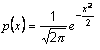
This section describes methods for plotting and analysising Standard Gaussian Probability Plots where the Standard Gaussian probabilty density function is defined as

Naming note: gaussianStandard may be replaced by normalStandard in the names of all these methods, e.g. normalStandardProbabilityPlot() performs the same function as gaussianStandardProbabilityPlot()

Calculate and Display a Standard Gaussian Probabilty Plot
public void gaussianStandardProbabilityPlot()
Usage:                      pp.gaussianStandardProbabilityPlot();
This method calculates and displays a Standard Gaussian probablity plot, i.e. a plot of the data entered via the Constructor (ordinate) against the corresponding Standard Gaussian order statistic medians (abscissa), and the best fit straight line. The data is first sorted into an ascending order.

Return the Correlation Coefficient
public double gaussianStandardCorrelationCoefficient()
Usage:                      rho = pp.gaussianStandardCorrelationCoefficient();
This method returns the correlation coefficient of the data entered via the Constructor and the corresponding Standard Gaussian order statistic medians. The data is first sorted into an ascending order.

Return the Gradient
public double gaussianStandardGradient()
Usage:                      gradient = pp.gaussianStandardGradient();
This method returns the gradient of the best straight line fit to the Standard Gaussian probability plot, i.e. a plot of the data entered via the Constructor (ordinate) against the corresponding Standard Gaussian order statistic medians (abscissa). The data is first sorted into an ascending order.

Return the Estimated Error of the Gradient
public double gaussianStandardGradientError()
Usage:                      gradientError = pp.gaussianStandardGradientError();
This method returns the estimated error of the gradient of the best straight line fit to the Standard Gaussian probability plot, i.e. a plot of the data entered via the Constructor (ordinate) against the corresponding Standard Gaussian order statistic medians (abscissa). The data is first sorted into an ascending order. The error is obtained from the linear regression.

Return the Intercept
public double gaussianStandardIntercept()
Usage:                      intercept = pp.gaussianStandardIntercept();
This method returns the intercept of the best straight line fit to the Standard Gaussian probability plot, i.e. a plot of the data entered via the Constructor (ordinate) against the corresponding Standard Gaussian order statistic medians (abscissa). The data is first sorted into an ascending order.

Return the Estimated Error of the Intercept
public double gaussianStandardInterceptError()
Usage:                      interceptError = pp.gaussianStandardInterceptError();
This method returns the estimated error of the intercept of the best straight line fit to the Standard Gaussian probability plot, i.e. a plot of the data entered via the Constructor (ordinate) against the corresponding Standard Gaussian order statistic medians (abscissa). The data is first sorted into an ascending order. The error is obtained from the linear regression.

Return the Sum of Squares
public double gaussianStandardSumOfSquares()
Usage:                      ss = pp.gaussianStandardSumOfSquares();
This method returns the sum of squares of the diferences in the data values entered via the Constructor and the corresponding Standard Gaussian order statistic median value. The data is first sorted into an ascending order.

Return the Standard gaussianStandard Order Statistic Medians
public double[] gaussianStandardOrderStatisticMedians()
Usage:                      gsom = pp.gaussianStandardOrderStatisticMedians();
This method returns the Standard Gaussian order statistic median used in the Probability Plot.


EXPONENTIAL PROBABILITY PLOT

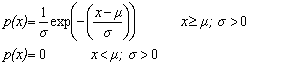
This section describes methods for plotting and analysising Exponential Probability Plots where the Exponential probabilty density function is defined as


Calculate and Display a Exponential Probabilty Plot
public void exponentialProbabilityPlot()
Usage:                      pp.exponentialProbabilityPlot();
This method calculates and displays a Exponential probablity plot, i.e. a plot of the data entered via the Constructor (ordinate) against the corresponding Exponential order statistic medians (abscissa), and the best fit straight line. The data is first sorted into an ascending order.

Return the Correlation Coefficient
public double exponentialCorrelationCoefficient()
Usage:                      rho = pp.exponentialCorrelationCoefficient();
This method returns the correlation coefficient of the data entered via the Constructor and the corresponding Exponential order statistic medians. The data is first sorted into an ascending order.

Return the Gradient
public double exponentialGradient()
Usage:                      gradient = pp.exponentialGradient();
This method returns the gradient of the best straight line fit to the Exponential probability plot, i.e. a plot of the data entered via the Constructor (ordinate) against the corresponding Exponential order statistic medians (abscissa). The data is first sorted into an ascending order.

Return the Estimated Error of the Gradient
public double exponentialGradientError()
Usage:                      gradientError = pp.exponentialGradientError();
This method returns the estimated error of the gradient of the best straight line fit to the Exponential probability plot, i.e. a plot of the data entered via the Constructor (ordinate) against the corresponding Exponential order statistic medians (abscissa). The data is first sorted into an ascending order. The error is obtained from the linear regression.

Return the Intercept
public double exponentialIntercept()
Usage:                      intercept = pp.exponentialIntercept();
This method returns the intercept of the best straight line fit to the Exponential probability plot, i.e. a plot of the data entered via the Constructor (ordinate) against the corresponding Exponential order statistic medians (abscissa). The data is first sorted into an ascending order.

Return the Estimated Error of the Intercept
public double exponentialInterceptError()
Usage:                      interceptError = pp.exponentialInterceptError();
This method returns the estimated error of the intercept of the best straight line fit to the Exponential probability plot, i.e. a plot of the data entered via the Constructor (ordinate) against the corresponding Exponential order statistic medians (abscissa). The data is first sorted into an ascending order. The error is obtained from the linear regression.

Return Exponential parameter &mu
public double exponentialMu()
Usage:                      mu = pp.exponentialMu();
This method returns the Exponential parameter, &mu, obtained from the best fit Probabilty Plot calculated as the one with the minimum sum of squares of the diferences in the data values entered via the Constructor and the corresponding Exponential order statistic median value. The data is first sorted into an ascending order.

Return the Estimated Error of the Exponential parameter &mu
public double exponentialMuError()
Usage:                      muError = pp.exponentialMuError();
This method returns the estimated error of the Exponential parameter, &mu. The error is obtained as the square root of the appropriate diagonal of a covariance matrix obtained as the inverse of the numerically calculated matrix of second derivatives of the sum of squares with respect to &mu, &sigma and &gamma. See also Warning.

Return Exponential parameter &sigma
public double exponentialSigma()
Usage:                      sigma = pp.exponentialSigma();
This method returns the Exponential parameter, &sigma, obtained from the best fit Probabilty Plot calculated as the one with the minimum sum of squares of the diferences in the data values entered via the Constructor and the corresponding Exponential order statistic median value. The data is first sorted into an ascending order.

Return the Estimated Error of the Exponential parameter &sigma
public double exponentialSigmaError()
Usage:                      sigmaError = pp.exponentialSigmaError();
This method returns the estimated error of the Exponential parameter, &sigma. The error is obtained as the square root of the appropriate diagonal of a covariance matrix obtained as the inverse of the numerically calculated matrix of second derivatives of the sum of squares with respect to &mu &sigma and &gamma. See also Warning>.

Return the Sum of Squares
public double exponentialSumOfSquares()
Usage:                      ss = pp.exponentialSumOfSquares();
This method returns the sum of squares of the diferences in the data values entered via the Constructor and the corresponding Exponential order statistic median value. The data is first sorted into an ascending order.

Return the Exponential Order Statistic Medians
public double[] exponentialOrderStatisticMedians()
Usage:                      gsom = pp.exponentialOrderStatisticMedians();
This method returns the Exponential order statistic median used in the Probability Plot.


F-DISTRIBUTION PROBABILITY PLOT

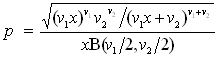
This section describes methods for plotting and analysising F-Distribution Probability Plots where the F-Distribution probabilty density function is defined as


Calculate and Display a F-Distribution Probabilty Plot
public void fDistributionProbabilityPlot(int nu1, int nu2)
Usage:                      pp.fDistributionProbabilityPlot(nu1, nu2);
This method calculates and displays a F-Distribution probablity plot, i.e. a plot of the data entered via the Constructor (ordinate) against the corresponding F-Distribution order statistic medians (abscissa), and the best fit straight line. The arguments, nu1 and nu2, are the degrees of freeedom, &nu1 and &nu2. The data is first sorted into an ascending order.

Return the Correlation Coefficient
public double fDistributionCorrelationCoefficient()
Usage:                      rho = pp.fDistributionCorrelationCoefficient();
This method returns the correlation coefficient of the data entered via the Constructor and the corresponding F-Distribution order statistic medians. The data is first sorted into an ascending order.

Return the Gradient
public double fDistributionGradient()
Usage:                      gradient = pp.fDistributionGradient();
This method returns the gradient of the best straight line fit to the F-Distribution probability plot, i.e. a plot of the data entered via the Constructor (ordinate) against the corresponding F-Distribution order statistic medians (abscissa). The data is first sorted into an ascending order.

Return the Estimated Error of the Gradient
public double fDistributionGradientError()
Usage:                      gradientError = pp.fDistributionGradientError();
This method returns the estimated error of the gradient of the best straight line fit to the F-Distribution probability plot, i.e. a plot of the data entered via the Constructor (ordinate) against the corresponding F-Distribution order statistic medians (abscissa). The data is first sorted into an ascending order. The error is obtained from the linear regression.

Return the Intercept
public double fDistributionIntercept()
Usage:                      intercept = pp.fDistributionIntercept();
This method returns the intercept of the best straight line fit to the F-Distribution probability plot, i.e. a plot of the data entered via the Constructor (ordinate) against the corresponding F-Distribution order statistic medians (abscissa). The data is first sorted into an ascending order.

Return the Estimated Error of the Intercept
public double fDistributionInterceptError()
Usage:                      interceptError = pp.fDistributionInterceptError();
This method returns the estimated error of the intercept of the best straight line fit to the F-Distribution probability plot, i.e. a plot of the data entered via the Constructor (ordinate) against the corresponding F-Distribution order statistic medians (abscissa). The data is first sorted into an ascending order. The error is obtained from the linear regression.

Return the Sum of Squares
public double fDistributionSumOfSquares()
Usage:                      ss = pp.fDistributionSumOfSquares();
This method returns the sum of squares of the diferences in the data values entered via the Constructor and the corresponding F-Distribution order statistic median value. The data is first sorted into an ascending order.

Return the F-Distribution Order Statistic Medians
public double[] fDistributionOrderStatisticMedians()
Usage:                      gsom = pp.fDistributionOrderStatisticMedians();
This method returns the F-Distribution order statistic median used in the Probability Plot.


FRÉCHET PROBABILITY PLOT

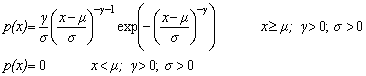
This section describes methods for plotting and analysising Fréchet Probability Plots where the Fréchet probabilty density function is defined as


Calculate and Display a Fréchet Probabilty Plot
public void frechetProbabilityPlot()
Usage:                      pp.frechetProbabilityPlot();
This method calculates and displays a Fréchet probablity plot, i.e. a plot of the data entered via the Constructor (ordinate) against the corresponding Fréchet order statistic medians (abscissa), and the best fit straight line. The data is first sorted into an ascending order.

Return the Correlation Coefficient
public double frechetCorrelationCoefficient()
Usage:                      rho = pp.frechetCorrelationCoefficient();
This method returns the correlation coefficient of the data entered via the Constructor and the corresponding Fréchet order statistic medians. The data is first sorted into an ascending order.

Return the Gradient
public double frechetGradient()
Usage:                      gradient = pp.frechetGradient();
This method returns the gradient of the best straight line fit to the Fréchet probability plot, i.e. a plot of the data entered via the Constructor (ordinate) against the corresponding Fréchet order statistic medians (abscissa). The data is first sorted into an ascending order.

Return the Estimated Error of the Gradient
public double frechetGradientError()
Usage:                      gradientError = pp.frechetGradientError();
This method returns the estimated error of the gradient of the best straight line fit to the Fréchet probability plot, i.e. a plot of the data entered via the Constructor (ordinate) against the corresponding Fréchet order statistic medians (abscissa). The data is first sorted into an ascending order. The error is obtained from the linear regression.

Return the Intercept
public double frechetIntercept()
Usage:                      intercept = pp.frechetIntercept();
This method returns the intercept of the best straight line fit to the Fréchet probability plot, i.e. a plot of the data entered via the Constructor (ordinate) against the corresponding Fréchet order statistic medians (abscissa). The data is first sorted into an ascending order.

Return the Estimated Error of the Intercept
public double frechetInterceptError()
Usage:                      interceptError = pp.frechetInterceptError();
This method returns the estimated error of the intercept of the best straight line fit to the Fréchet probability plot, i.e. a plot of the data entered via the Constructor (ordinate) against the corresponding Fréchet order statistic medians (abscissa). The data is first sorted into an ascending order. The error is obtained from the linear regression.

Return Fréchet parameter &mu
public double frechetMu()
Usage:                      mu = pp.frechetMu();
This method returns the Fréchet parameter, &mu, obtained from the best fit Probabilty Plot calculated as the one with the minimum sum of squares of the diferences in the data values entered via the Constructor and the corresponding Fréchet order statistic median value. The data is first sorted into an ascending order.

Return the Estimated Error of the Fréchet parameter &mu
public double frechetMuError()
Usage:                      muError = pp.frechetMuError();
This method returns the estimated error of the Fréchet parameter, &mu. The error is obtained as the square root of the appropriate diagonal of a covariance matrix obtained as the inverse of the numerically calculated matrix of second derivatives of the sum of squares with respect to &mu and &sigma. See also Warning.

Return Fréchet parameter &sigma
public double frechetSigma()
Usage:                      sigma = pp.frechetSigma();
This method returns the Fréchet parameter, &sigma, obtained from the best fit Probabilty Plot calculated as the one with the minimum sum of squares of the diferences in the data values entered via the Constructor and the corresponding Fréchet order statistic median value. The data is first sorted into an ascending order.

Return the Estimated Error of the Fréchet parameter &sigma
public double frechetSigmaError()
Usage:                      sigmaError = pp.frechetSigmaError();
This method returns the estimated error of the Fréchet parameter, &sigma. The error is obtained as the square root of the appropriate diagonal of a covariance matrix obtained as the inverse of the numerically calculated matrix of second derivatives of the sum of squares with respect to &mu and &sigma. See also Warning.

Return Fréchet parameter &gamma
public double frechetGamma()
Usage:                      gamma = pp.frechetGamma();
This method returns the Fréchet parameter, &gamma, obtained from the best fit Probabilty Plot calculated as the one with the minimum sum of squares of the diferences in the data values entered via the Constructor and the corresponding Fréchet order statistic median value. The data is first sorted into an ascending order.

Return the Estimated Error of the Fréchet parameter &gamma
public double frechetGammaError()
Usage:                      gammaError = pp.frechetGammaError();
This method returns the estimated error of the Fréchet parameter, &gamma. The error is obtained as the square root of the appropriate diagonal of a covariance matrix obtained as the inverse of the numerically calculated matrix of second derivatives of the sum of squares with respect to &mu and &sigma. See also Warning.

Return the Sum of Squares
public double frechetSumOfSquares()
Usage:                      ss = pp.frechetSumOfSquares();
This method returns the sum of squares of the diferences in the data values entered via the Constructor and the corresponding Fréchet order statistic median value. The data is first sorted into an ascending order.

Return the Fréchet Order Statistic Medians
public double[] frechetOrderStatisticMedians()
Usage:                      gsom = pp.frechetOrderStatisticMedians();
This method returns the Fréchet order statistic median used in the Probability Plot.


GUMBEL (MINIMUM ORDER STATISTIC) PROBABILITY PLOT

This section describes methods for plotting and analysising Gumbel (minimim order statistic) Probability Plots where the Gumbel (minimim order statistic) probabilty density function is defined as


Calculate and Display a Gumbel (minimim order statistic) Probabilty Plot
public void gumbelminProbabilityPlot()
Usage:                      pp.gumbelminProbabilityPlot();
This method calculates and displays a Gumbel (minimim order statistic) probablity plot, i.e. a plot of the data entered via the Constructor (ordinate) against the corresponding Gumbel (minimim order statistic) order statistic medians (abscissa), and the best fit straight line. The data is first sorted into an ascending order.

Return the Correlation Coefficient
public double gumbelminCorrelationCoefficient()
Usage:                      rho = pp.gumbelminCorrelationCoefficient();
This method returns the correlation coefficient of the data entered via the Constructor and the corresponding Gumbel (minimim order statistic) order statistic medians. The data is first sorted into an ascending order.

Return the Gradient
public double gumbelminGradient()
Usage:                      gradient = pp.gumbelminGradient();
This method returns the gradient of the best straight line fit to the Gumbel (minimim order statistic) probability plot, i.e. a plot of the data entered via the Constructor (ordinate) against the corresponding Gumbel (minimim order statistic) order statistic medians (abscissa). The data is first sorted into an ascending order.

Return the Estimated Error of the Gradient
public double gumbelminGradientError()
Usage:                      gradientError = pp.gumbelminGradientError();
This method returns the estimated error of the gradient of the best straight line fit to the Gumbel (minimim order statistic) probability plot, i.e. a plot of the data entered via the Constructor (ordinate) against the corresponding Gumbel (minimim order statistic) order statistic medians (abscissa). The data is first sorted into an ascending order. The error is obtained from the linear regression.

Return the Intercept
public double gumbelminIntercept()
Usage:                      intercept = pp.gumbelminIntercept();
This method returns the intercept of the best straight line fit to the Gumbel (minimim order statistic) probability plot, i.e. a plot of the data entered via the Constructor (ordinate) against the corresponding Gumbel (minimim order statistic) order statistic medians (abscissa). The data is first sorted into an ascending order.

Return the Estimated Error of the Intercept
public double gumbelminInterceptError()
Usage:                      interceptError = pp.gumbelminInterceptError();
This method returns the estimated error of the intercept of the best straight line fit to the Gumbel (minimim order statistic) probability plot, i.e. a plot of the data entered via the Constructor (ordinate) against the corresponding Gumbel (minimim order statistic) order statistic medians (abscissa). The data is first sorted into an ascending order. The error is obtained from the linear regression.

Return Gumbel (minimim order statistic) parameter &mu
public double gumbelminMu()
Usage:                      mu = pp.gumbelminMu();
This method returns the Gumbel (minimim order statistic) parameter, &mu, obtained from the best fit Probabilty Plot calculated as the one with the minimum sum of squares of the diferences in the data values entered via the Constructor and the corresponding Gumbel (minimim order statistic) order statistic median value. The data is first sorted into an ascending order.

Return the Estimated Error of the Gumbel (minimim order statistic) parameter &mu
public double gumbelminMuError()
Usage:                      muError = pp.gumbelminMuError();
This method returns the estimated error of the Gumbel (minimim order statistic) parameter, &mu. The error is obtained as the square root of the appropriate diagonal of a covariance matrix obtained as the inverse of the numerically calculated matrix of second derivatives of the sum of squares with respect to &mu and &sigma. See also Warning.

Return Gumbel (minimim order statistic) parameter &sigma
public double gumbelminSigma()
Usage:                      sigma = pp.gumbelminSigma();
This method returns the Gumbel (minimim order statistic) parameter, &sigma, obtained from the best fit Probabilty Plot calculated as the one with the minimum sum of squares of the diferences in the data values entered via the Constructor and the corresponding Gumbel (minimim order statistic) order statistic median value. The data is first sorted into an ascending order.

Return the Estimated Error of the Gumbel (minimim order statistic) parameter &sigma
public double gumbelminSigmaError()
Usage:                      sigmaError = pp.gumbelminSigmaError();
This method returns the estimated error of the Gumbel (minimim order statistic) parameter, &sigma. The error is obtained as the square root of the appropriate diagonal of a covariance matrix obtained as the inverse of the numerically calculated matrix of second derivatives of the sum of squares with respect to &mu and &sigma. See also Warning.

Return the Sum of Squares
public double gumbelminSumOfSquares()
Usage:                      ss = pp.gumbelminSumOfSquares();
This method returns the sum of squares of the diferences in the data values entered via the Constructor and the corresponding Gumbel (minimim order statistic) order statistic median value. The data is first sorted into an ascending order.

Return the Gumbel (minimim order statistic) Order Statistic Medians
public double[] gumbelminOrderStatisticMedians()
Usage:                      gsom = pp.gumbelminOrderStatisticMedians();
This method returns the Gumbel (minimim order statistic) order statistic median used in the Probability Plot.


GUMBEL (MAXIMUM ORDER STATISTIC) PROBABILITY PLOT

This section describes methods for plotting and analysising Gumbel (maximim order statistic) Probability Plots where the Gumbel (maximim order statistic) probabilty density function is defined as


Calculate and Display a Gumbel (maximim order statistic) Probabilty Plot
public void gumbelMaxProbabilityPlot()
Usage:                      pp.gumbelMaxProbabilityPlot();
This method calculates and displays a Gumbel (maximim order statistic) probablity plot, i.e. a plot of the data entered via the Constructor (ordinate) against the corresponding Gumbel (maximim order statistic) order statistic medians (abscissa), and the best fit straight line. The data is first sorted into an ascending order.

Return the Correlation Coefficient
public double gumbelMaxCorrelationCoefficient()
Usage:                      rho = pp.gumbelMaxCorrelationCoefficient();
This method returns the correlation coefficient of the data entered via the Constructor and the corresponding Gumbel (maximim order statistic) order statistic medians. The data is first sorted into an ascending order.

Return the Gradient
public double gumbelMaxGradient()
Usage:                      gradient = pp.gumbelMaxGradient();
This method returns the gradient of the best straight line fit to the Gumbel (maximim order statistic) probability plot, i.e. a plot of the data entered via the Constructor (ordinate) against the corresponding Gumbel (maximim order statistic) order statistic medians (abscissa). The data is first sorted into an ascending order.

Return the Estimated Error of the Gradient
public double gumbelMaxGradientError()
Usage:                      gradientError = pp.gumbelMaxGradientError();
This method returns the estimated error of the gradient of the best straight line fit to the Gumbel (maximim order statistic) probability plot, i.e. a plot of the data entered via the Constructor (ordinate) against the corresponding Gumbel (maximim order statistic) order statistic medians (abscissa). The data is first sorted into an ascending order. The error is obtained from the linear regression.

Return the Intercept
public double gumbelMaxIntercept()
Usage:                      intercept = pp.gumbelMaxIntercept();
This method returns the intercept of the best straight line fit to the Gumbel (maximim order statistic) probability plot, i.e. a plot of the data entered via the Constructor (ordinate) against the corresponding Gumbel (maximim order statistic) order statistic medians (abscissa). The data is first sorted into an ascending order.

Return the Estimated Error of the Intercept
public double gumbelMaxInterceptError()
Usage:                      interceptError = pp.gumbelMaxInterceptError();
This method returns the estimated error of the intercept of the best straight line fit to the Gumbel (maximim order statistic) probability plot, i.e. a plot of the data entered via the Constructor (ordinate) against the corresponding Gumbel (maximim order statistic) order statistic medians (abscissa). The data is first sorted into an ascending order. The error is obtained from the linear regression.

Return Gumbel (maximim order statistic) parameter &mu
public double gumbelMaxMu()
Usage:                      mu = pp.gumbelMaxMu();
This method returns the Gumbel (maximim order statistic) parameter, &mu, obtained from the best fit Probabilty Plot calculated as the one with the minimum sum of squares of the diferences in the data values entered via the Constructor and the corresponding Gumbel (maximim order statistic) order statistic median value. The data is first sorted into an ascending order.

Return the Estimated Error of the Gumbel (maximim order statistic) parameter &mu
public double gumbelMaxMuError()
Usage:                      muError = pp.gumbelMaxMuError();
This method returns the estimated error of the Gumbel (maximim order statistic) parameter, &mu. The error is obtained as the square root of the appropriate diagonal of a covariance matrix obtained as the inverse of the numerically calculated matrix of second derivatives of the sum of squares with respect to &mu and &sigma. See also Warning.

Return Gumbel (maximim order statistic) parameter &sigma
public double gumbelMaxSigma()
Usage:                      sigma = pp.gumbelMaxSigma();
This method returns the Gumbel (maximim order statistic) parameter, &sigma, obtained from the best fit Probabilty Plot calculated as the one with the minimum sum of squares of the diferences in the data values entered via the Constructor and the corresponding Gumbel (maximim order statistic) order statistic median value. The data is first sorted into an ascending order.

Return the Estimated Error of the Gumbel (maximim order statistic) parameter &sigma
public double gumbelMaxSigmaError()
Usage:                      sigmaError = pp.gumbelMaxSigmaError();
This method returns the estimated error of the Gumbel (maximim order statistic) parameter, &sigma. The error is obtained as the square root of the appropriate diagonal of a covariance matrix obtained as the inverse of the numerically calculated matrix of second derivatives of the sum of squares with respect to &mu and &sigma. See also Warning.

Return the Sum of Squares
public double gumbelMaxSumOfSquares()
Usage:                      ss = pp.gumbelMaxSumOfSquares();
This method returns the sum of squares of the diferences in the data values entered via the Constructor and the corresponding Gumbel (maximim order statistic) order statistic median value. The data is first sorted into an ascending order.

Return the Gumbel (maximim order statistic) Order Statistic Medians
public double[] gumbelMaxOrderStatisticMedians()
Usage:                      gsom = pp.gumbelMaxOrderStatisticMedians();
This method returns the Gumbel (maximim order statistic) order statistic median used in the Probability Plot.


LOGISIC PROBABILITY PLOT

This section describes methods for plotting and analysising Logistic Probability Plots where the Logistic probabilty density function is defined as


Calculate and Display a Logistic Probabilty Plot
public void logisticProbabilityPlot()
Usage:                      pp.logisticProbabilityPlot();
This method calculates and displays a Logistic probablity plot, i.e. a plot of the data entered via the Constructor (ordinate) against the corresponding Logistic order statistic medians (abscissa), and the best fit straight line. The data is first sorted into an ascending order.

Return the Correlation Coefficient
public double logisticCorrelationCoefficient()
Usage:                      rho = pp.logisticCorrelationCoefficient();
This method returns the correlation coefficient of the data entered via the Constructor and the corresponding Logistic order statistic medians. The data is first sorted into an ascending order.

Return the Gradient
public double logisticGradient()
Usage:                      gradient = pp.logisticGradient();
This method returns the gradient of the best straight line fit to the Logistic probability plot, i.e. a plot of the data entered via the Constructor (ordinate) against the corresponding Logistic order statistic medians (abscissa). The data is first sorted into an ascending order.

Return the Estimated Error of the Gradient
public double logisticGradientError()
Usage:                      gradientError = pp.logisticGradientError();
This method returns the estimated error of the gradient of the best straight line fit to the Logistic probability plot, i.e. a plot of the data entered via the Constructor (ordinate) against the corresponding Logistic order statistic medians (abscissa). The data is first sorted into an ascending order. The error is obtained from the linear regression.

Return the Intercept
public double logisticIntercept()
Usage:                      intercept = pp.logisticIntercept();
This method returns the intercept of the best straight line fit to the Logistic probability plot, i.e. a plot of the data entered via the Constructor (ordinate) against the corresponding Logistic order statistic medians (abscissa). The data is first sorted into an ascending order.

Return the Estimated Error of the Intercept
public double logisticInterceptError()
Usage:                      interceptError = pp.logisticInterceptError();
This method returns the estimated error of the intercept of the best straight line fit to the Logistic probability plot, i.e. a plot of the data entered via the Constructor (ordinate) against the corresponding Logistic order statistic medians (abscissa). The data is first sorted into an ascending order. The error is obtained from the linear regression.

Return Logistic parameter &mu
public double logisticMu()
Usage:                      mu = pp.logisticMu();
This method returns the Logistic parameter, &mu, obtained from the best fit Probabilty Plot calculated as the one with the minimum sum of squares of the diferences in the data values entered via the Constructor and the corresponding Logistic order statistic median value. The data is first sorted into an ascending order.

Return the Estimated Error of the Logistic parameter &mu
public double logisticMuError()
Usage:                      muError = pp.logisticMuError();
This method returns the estimated error of the Logistic parameter, &mu. The error is obtained as the square root of the appropriate diagonal of a covariance matrix obtained as the inverse of the numerically calculated matrix of second derivatives of the sum of squares with respect to &mu and &sigma. See also Warning.

Return Logistic parameter σ
public double logisticSigma()
Usage:                      sigma = pp.logisticSigma();
This method returns the Logistic parameter, σ, obtained from the best fit Probabilty Plot calculated as the one with the minimum sum of squares of the diferences in the data values entered via the Constructor and the corresponding Logistic order statistic median value. The data is first sorted into an ascending order.

Return the Estimated Error of the Logistic parameter σ
public double logisticSigmaError()
Usage:                      sigmaError = pp.logisticSigmaError();
This method returns the estimated error of the Logistic parameter, σ. The error is obtained as the square root of the appropriate diagonal of a covariance matrix obtained as the inverse of the numerically calculated matrix of second derivatives of the sum of squares with respect to &mu and &sigma. See also Warning.

Return the Sum of Squares
public double logisticSumOfSquares()
Usage:                      ss = pp.logisticSumOfSquares();
This method returns the sum of squares of the diferences in the data values entered via the Constructor and the corresponding Logistic order statistic median value. The data is first sorted into an ascending order.

Return the Logistic Order Statistic Medians
public double[] logisticOrderStatisticMedians()
Usage:                      gsom = pp.logisticOrderStatisticMedians();
This method returns the Logistic order statistic median used in the Probability Plot.


PARETO PROBABILITY PLOT

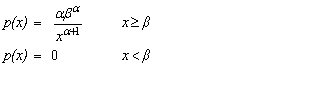
This section describes methods for plotting and analysising Pareto Probability Plots where the Pareto probabilty density function is defined as


Calculate and Display a Pareto Probabilty Plot
public void paretoProbabilityPlot()
Usage:                      pp.paretoProbabilityPlot();
This method calculates and displays a Pareto probablity plot, i.e. a plot of the data entered via the Constructor (ordinate) against the corresponding Pareto order statistic medians (abscissa), and the best fit straight line. The data is first sorted into an ascending order.

Return the Correlation Coefficient
public double paretoCorrelationCoefficient()
Usage:                      rho = pp.paretoCorrelationCoefficient();
This method returns the correlation coefficient of the data entered via the Constructor and the corresponding Pareto order statistic medians. The data is first sorted into an ascending order.

Return the Gradient
public double paretoGradient()
Usage:                      gradient = pp.paretoGradient();
This method returns the gradient of the best straight line fit to the Pareto probability plot, i.e. a plot of the data entered via the Constructor (ordinate) against the corresponding Pareto order statistic medians (abscissa). The data is first sorted into an ascending order.

Return the Estimated Error of the Gradient
public double paretoGradientError()
Usage:                      gradientError = pp.paretoGradientError();
This method returns the estimated error of the gradient of the best straight line fit to the Pareto probability plot, i.e. a plot of the data entered via the Constructor (ordinate) against the corresponding Pareto order statistic medians (abscissa). The data is first sorted into an ascending order. The error is obtained from the linear regression.

Return the Intercept
public double paretoIntercept()
Usage:                      intercept = pp.paretoIntercept();
This method returns the intercept of the best straight line fit to the Pareto probability plot, i.e. a plot of the data entered via the Constructor (ordinate) against the corresponding Pareto order statistic medians (abscissa). The data is first sorted into an ascending order.

Return the Estimated Error of the Intercept
public double paretoInterceptError()
Usage:                      interceptError = pp.paretoInterceptError();
This method returns the estimated error of the intercept of the best straight line fit to the Pareto probability plot, i.e. a plot of the data entered via the Constructor (ordinate) against the corresponding Pareto order statistic medians (abscissa). The data is first sorted into an ascending order. The error is obtained from the linear regression.

Return Pareto parameter &alpha
public double paretoAlpha()
Usage:                      alpha = pp.paretoAlpha();
This method returns the Pareto parameter, &alpha, obtained from the best fit Probabilty Plot calculated as the one with the minimum sum of squares of the diferences in the data values entered via the Constructor and the corresponding Pareto order statistic median value. The data is first sorted into an ascending order.

Return the Estimated Error of the Pareto parameter &alpha
public double paretoAlphaError()
Usage:                      alphaError = pp.paretoAlphaError();
This method returns the estimated error of the Pareto parameter, &alpha. The error is obtained as the square root of the appropriate diagonal of a covariance matrix obtained as the inverse of the numerically calculated matrix of second derivatives of the sum of squares with respect to &alpha and &beta. See also Warning.

Return Pareto parameter &beta
public double paretoBeta()
Usage:                      beta = pp.paretoBeta();
This method returns the Pareto parameter, &beta, obtained from the best fit Probabilty Plot calculated as the one with the minimum sum of squares of the diferences in the data values entered via the Constructor and the corresponding Pareto order statistic median value. The data is first sorted into an ascending order.

Return the Estimated Error of the Pareto parameter &beta
public double paretoBetaError()
Usage:                      betaError = pp.paretoBetaError();
This method returns the estimated error of the Pareto parameter, &beta. The error is obtained as the square root of the appropriate diagonal of a covariance matrix obtained as the inverse of the numerically calculated matrix of second derivatives of the sum of squares with respect to &alpha and &beta. See also Warning.

Return the Sum of Squares
public double paretoSumOfSquares()
Usage:                      ss = pp.paretoSumOfSquares();
This method returns the sum of squares of the diferences in the data values entered via the Constructor and the corresponding Pareto order statistic median value. The data is first sorted into an ascending order.

Return the Pareto Order Statistic Medians
public double[] paretoOrderStatisticMedians()
Usage:                      gsom = pp.paretoOrderStatisticMedians();
This method returns the Pareto order statistic median used in the Probability Plot.


RAYLEIGH PROBABILITY PLOT

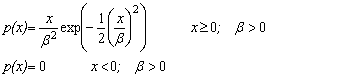
This section describes methods for plotting and analysising Rayleigh Probability Plots where the Rayleigh probabilty density function is defined as


Calculate and Display a Rayleigh Probabilty Plot
public void rayleighProbabilityPlot()
Usage:                      pp.rayleighProbabilityPlot();
This method calculates and displays a Rayleigh probablity plot, i.e. a plot of the data entered via the Constructor (ordinate) against the corresponding Rayleigh order statistic medians (abscissa), and the best fit straight line. The data is first sorted into an ascending order.

Return the Correlation Coefficient
public double rayleighCorrelationCoefficient()
Usage:                      rho = pp.rayleighCorrelationCoefficient();
This method returns the correlation coefficient of the data entered via the Constructor and the corresponding Rayleigh order statistic medians. The data is first sorted into an ascending order.

Return the Gradient
public double rayleighGradient()
Usage:                      gradient = pp.rayleighGradient();
This method returns the gradient of the best straight line fit to the Rayleigh probability plot, i.e. a plot of the data entered via the Constructor (ordinate) against the corresponding Rayleigh order statistic medians (abscissa). The data is first sorted into an ascending order.

Return the Estimated Error of the Gradient
public double rayleighGradientError()
Usage:                      gradientError = pp.rayleighGradientError();
This method returns the estimated error of the gradient of the best straight line fit to the Rayleigh probability plot, i.e. a plot of the data entered via the Constructor (ordinate) against the corresponding Rayleigh order statistic medians (abscissa). The data is first sorted into an ascending order. The error is obtained from the linear regression.

Return the Intercept
public double rayleighIntercept()
Usage:                      intercept = pp.rayleighIntercept();
This method returns the intercept of the best straight line fit to the Rayleigh probability plot, i.e. a plot of the data entered via the Constructor (ordinate) against the corresponding Rayleigh order statistic medians (abscissa). The data is first sorted into an ascending order.

Return the Estimated Error of the Intercept
public double rayleighInterceptError()
Usage:                      interceptError = pp.rayleighInterceptError();
This method returns the estimated error of the intercept of the best straight line fit to the Rayleigh probability plot, i.e. a plot of the data entered via the Constructor (ordinate) against the corresponding Rayleigh order statistic medians (abscissa). The data is first sorted into an ascending order. The error is obtained from the linear regression.

Return Rayleigh parameter &beta
public double rayleighBeta()
Usage:                      beta = pp.rayleighBeta();
This method returns the Rayleigh parameter, &beta, obtained from the best fit Probabilty Plot calculated as the one with the minimum sum of squares of the diferences in the data values entered via the Constructor and the corresponding Rayleigh order statistic median value. The data is first sorted into an ascending order.

Return the Estimated Error of the Rayleigh parameter &beta
public double rayleighBetaError()
Usage:                      betaError = pp.rayleighBetaError();
This method returns the estimated error of the Rayleigh parameter, &beta. The error is obtained as the square root of the inverse of the second derivative of the sum of squares with respect to &beta. See also Warning.

Return the Sum of Squares
public double rayleighSumOfSquares()
Usage:                      ss = pp.rayleighSumOfSquares();
This method returns the sum of squares of the diferences in the data values entered via the Constructor and the corresponding Rayleigh order statistic median value. The data is first sorted into an ascending order.

Return the Rayleigh Order Statistic Medians
public double[] rayleighOrderStatisticMedians()
Usage:                      gsom = pp.rayleighOrderStatisticMedians();
This method returns the Rayleigh order statistic median used in the Probability Plot.


WEIBULL PROBABILITY PLOTS

THREE PARAMETER WEIBULL PROBABILITY PLOT
See below for the Two Parameter Weibull and the Standard Weibull Probability Plots

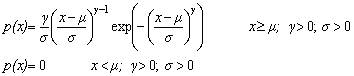
This section describes methods for plotting and analysising Three Parameter Weibull Probability Plots where the Three Parameter Weibull probabilty density function is defined as


Calculate and Display a Three Parameter Weibull Probabilty Plot
public void weibullProbabilityPlot()
Usage:                      pp.weibullProbabilityPlot();
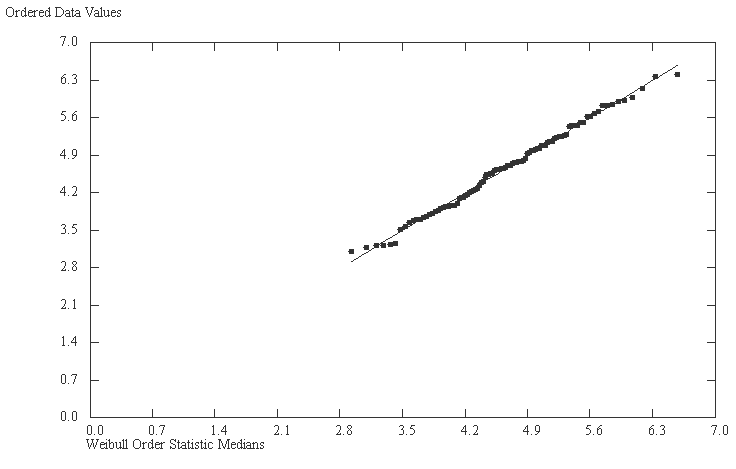
This method calculates and displays a Three Parameter Weibull probablity plot, i.e. a plot of the data entered via the Constructor (ordinate) against the corresponding Three Parameter Weibull order statistic medians (abscissa), and the best fit straight line. The data is first sorted into an ascending order.

Return the Correlation Coefficient
public double weibullCorrelationCoefficient()
Usage:                      rho = pp.weibullCorrelationCoefficient();
This method returns the correlation coefficient of the data entered via the Constructor and the corresponding Three Parameter Weibull order statistic medians. The data is first sorted into an ascending order.

Return the Gradient
public double weibullGradient()
Usage:                      gradient = pp.weibullGradient();
This method returns the gradient of the best straight line fit to the Three Parameter Weibull probability plot, i.e. a plot of the data entered via the Constructor (ordinate) against the corresponding Three Parameter Weibull order statistic medians (abscissa). The data is first sorted into an ascending order.

Return the Estimated Error of the Gradient
public double weibullGradientError()
Usage:                      gradientError = pp.weibullGradientError();
This method returns the estimated error of the gradient of the best straight line fit to the Three Parameter Weibull probability plot, i.e. a plot of the data entered via the Constructor (ordinate) against the corresponding Three Parameter Weibull order statistic medians (abscissa). The data is first sorted into an ascending order. The error is obtained from the linear regression.

Return the Intercept
public double weibullIntercept()
Usage:                      intercept = pp.weibullIntercept();
This method returns the intercept of the best straight line fit to the Three Parameter Weibull probability plot, i.e. a plot of the data entered via the Constructor (ordinate) against the corresponding Three Parameter Weibull order statistic medians (abscissa). The data is first sorted into an ascending order.

Return the Estimated Error of the Intercept
public double weibullInterceptError()
Usage:                      interceptError = pp.weibullInterceptError();
This method returns the estimated error of the intercept of the best straight line fit to the Three Parameter Weibull probability plot, i.e. a plot of the data entered via the Constructor (ordinate) against the corresponding Three Parameter Weibull order statistic medians (abscissa). The data is first sorted into an ascending order. The error is obtained from the linear regression.

Return Three Parameter Weibull parameter &mu
public double weibullMu()
Usage:                      mu = pp.weibullMu();
This method returns the Three Parameter Weibull parameter, &mu, obtained from the best fit Probabilty Plot calculated as the one with the minimum sum of squares of the diferences in the data values entered via the Constructor and the corresponding Three Parameter Weibull order statistic median value. The data is first sorted into an ascending order.

Return the Estimated Error of the Three Parameter Weibull parameter &mu
public double weibullMuError()
Usage:                      muError = pp.weibullMuError();
This method returns the estimated error of the Three Parameter Weibull parameter, &mu. The error is obtained as the square root of the appropriate diagonal of a covariance matrix obtained as the inverse of the numerically calculated matrix of second derivatives of the sum of squares with respect to &mu and &sigma. See also Warning.

Return Three Parameter Weibull parameter &sigma
public double weibullSigma()
Usage:                      sigma = pp.weibullSigma();
This method returns the Three Parameter Weibull parameter, &sigma, obtained from the best fit Probabilty Plot calculated as the one with the minimum sum of squares of the diferences in the data values entered via the Constructor and the corresponding Three Parameter Weibull order statistic median value. The data is first sorted into an ascending order.

Return the Estimated Error of the Three Parameter Weibull parameter &sigma
public double weibullSigmaError()
Usage:                      sigmaError = pp.weibullSigmaError();
This method returns the estimated error of the Three Parameter Weibull parameter, &sigma. The error is obtained as the square root of the appropriate diagonal of a covariance matrix obtained as the inverse of the numerically calculated matrix of second derivatives of the sum of squares with respect to &mu and &sigma. See also Warning.

Return Three Parameter Weibull parameter &gamma
public double weibullGamma()
Usage:                      gamma = pp.weibullGamma();
This method returns the Three Parameter Weibull parameter, &gamma, obtained from the best fit Probabilty Plot calculated as the one with the minimum sum of squares of the diferences in the data values entered via the Constructor and the corresponding Three Parameter Weibull order statistic median value. The data is first sorted into an ascending order.

Return the Estimated Error of the Three Parameter Weibull parameter &gamma
public double weibullGammaError()
Usage:                      gammaError = pp.weibullGammaError();
This method returns the estimated error of the Three Parameter Weibull parameter, &gamma. The error is obtained as the square root of the appropriate diagonal of a covariance matrix obtained as the inverse of the numerically calculated matrix of second derivatives of the sum of squares with respect to &mu and &sigma. See also Warning.

Return the Sum of Squares
public double weibullSumOfSquares()
Usage:                      ss = pp.weibullSumOfSquares();
This method returns the sum of squares of the diferences in the data values entered via the Constructor and the corresponding Three Parameter Weibull order statistic median value. The data is first sorted into an ascending order.

Return the Three Parameter Weibull Order Statistic Medians
public double[] weibullOrderStatisticMedians()
Usage:                      gsom = pp.weibullOrderStatisticMedians();
This method returns the Three Parameter Weibull order statistic median used in the Probability Plot.


TWO PARAMETER WEIBULL PROBABILITY PLOT
See above for the Three Parameter Weibull and below for the Standard Weibull Probability Plots

This section describes methods for plotting and analysising Two Parameter Weibull Probability Plots where the Weibull probabilty density function is defined as


Calculate and Display a Weibull Probabilty Plot
public void weibullTwoParProbabilityPlot()
Usage:                      pp.weibullTwoParProbabilityPlot();
This method calculates and displays a Two Parameter Weibull probablity plot, i.e. a plot of the data entered via the Constructor (ordinate) against the corresponding Two Parameter Weibull order statistic medians (abscissa), and the best fit straight line. The data is first sorted into an ascending order.

Return the Correlation Coefficient
public double weibullTwoParCorrelationCoefficient()
Usage:                      rho = pp.weibullTwoParCorrelationCoefficient();
This method returns the correlation coefficient of the data entered via the Constructor and the corresponding Two Parameter Weibull order statistic medians. The data is first sorted into an ascending order.

Return the Gradient
public double weibullTwoParGradient()
Usage:                      gradient = pp.weibullTwoParGradient();
This method returns the gradient of the best straight line fit to the Two Parameter Weibull probability plot, i.e. a plot of the data entered via the Constructor (ordinate) against the corresponding Two Parameter Weibull order statistic medians (abscissa). The data is first sorted into an ascending order.

Return the Estimated Error of the Gradient
public double weibullTwoParGradientError()
Usage:                      gradientError = pp.weibullTwoParGradientError();
This method returns the estimated error of the gradient of the best straight line fit to the Two Parameter Weibull probability plot, i.e. a plot of the data entered via the Constructor (ordinate) against the corresponding Two Parameter Weibull order statistic medians (abscissa). The data is first sorted into an ascending order. The error is obtained from the linear regression.

Return the Intercept
public double weibullTwoParIntercept()
Usage:                      intercept = pp.weibullTwoParIntercept();
This method returns the intercept of the best straight line fit to the Two Parameter Weibull probability plot, i.e. a plot of the data entered via the Constructor (ordinate) against the corresponding Two Parameter Weibull order statistic medians (abscissa). The data is first sorted into an ascending order.

Return the Estimated Error of the Intercept
public double weibullTwoParInterceptError()
Usage:                      interceptError = pp.weibullTwoParInterceptError();
This method returns the estimated error of the intercept of the best straight line fit to the Two Parameter Weibull probability plot, i.e. a plot of the data entered via the Constructor (ordinate) against the corresponding Two Parameter Weibull order statistic medians (abscissa). The data is first sorted into an ascending order. The error is obtained from the linear regression.

Return Two Parameter Weibull parameter &sigma
public double weibullTwoParSigma()
Usage:                      sigma = pp.weibullTwoParSigma();
This method returns the Two Parameter Weibull parameter, &sigma, obtained from the best fit Probabilty Plot calculated as the one with the minimum sum of squares of the diferences in the data values entered via the Constructor and the corresponding Two Parameter Weibull order statistic median value. The data is first sorted into an ascending order.

Return the Estimated Error of the Two Parameter Weibull parameter &sigma
public double weibullTwoParSigmaError()
Usage:                      sigmaError = pp.weibullTwoParSigmaError();
This method returns the estimated error of the Two Parameter Weibull parameter, &sigma. The error is obtained as the square root of the appropriate diagonal of a covariance matrix obtained as the inverse of the numerically calculated matrix of second derivatives of the sum of squares with respect to &mu and &sigma. See also Warning.

Return Two Parameter Weibull parameter &gamma
public double weibullTwoParGamma()
Usage:                      gamma = pp.weibullTwoParGamma();
This method returns the Two Parameter Weibull parameter, &gamma, obtained from the best fit Probabilty Plot calculated as the one with the minimum sum of squares of the diferences in the data values entered via the Constructor and the corresponding Two Parameter Weibull order statistic median value. The data is first sorted into an ascending order.

Return the Estimated Error of the Two Parameter Weibull parameter &gamma
public double weibullTwoParGammaError()
Usage:                      gammaError = pp.weibullTwoParGammaError();
This method returns the estimated error of the Two Parameter Weibull parameter, &gamma. The error is obtained as the square root of the appropriate diagonal of a covariance matrix obtained as the inverse of the numerically calculated matrix of second derivatives of the sum of squares with respect to &mu and &sigma. See also Warning.

Return the Sum of Squares
public double weibullTwoParSumOfSquares()
Usage:                      ss = pp.weibullTwoParSumOfSquares();
This method returns the sum of squares of the diferences in the data values entered via the Constructor and the corresponding Two Parameter Weibull order statistic median value. The data is first sorted into an ascending order.

Return the Two Parameter Weibull Order Statistic Medians
public double[] weibullTwoParOrderStatisticMedians()
Usage:                      gsom = pp.weibullTwoParOrderStatisticMedians();
This method returns the Two Parameter Weibull order statistic median used in the Probability Plot.


STANDARD WEIBULL PROBABILITY PLOT
See above for the Three Parameter Weibull and the Two Parameter Weibull Probability Plots

This section describes methods for plotting and analysising Standard Weibull Probability Plots where the Weibull probabilty density function is defined as


Calculate and Display a Weibull Probabilty Plot
public void weibullTwoParProbabilityPlot()
Usage:                      pp.weibullStandardProbabilityPlot();
This method calculates and displays a Standard Weibull probablity plot, i.e. a plot of the data entered via the Constructor (ordinate) against the corresponding Standard Weibull order statistic medians (abscissa), and the best fit straight line. The data is first sorted into an ascending order.

Return the Correlation Coefficient
public double weibullStandardCorrelationCoefficient()
Usage:                      rho = pp.weibullStandardCorrelationCoefficient();
This method returns the correlation coefficient of the data entered via the Constructor and the corresponding Standard Weibull order statistic medians. The data is first sorted into an ascending order.

Return the Gradient
public double weibullStandardGradient()
Usage:                      gradient = pp.weibullStandardGradient();
This method returns the gradient of the best straight line fit to the Standard Weibull probability plot, i.e. a plot of the data entered via the Constructor (ordinate) against the corresponding Standard Weibull order statistic medians (abscissa). The data is first sorted into an ascending order.

Return the Estimated Error of the Gradient
public double weibullStandardGradientError()
Usage:                      gradientError = pp.weibullStandardGradientError();
This method returns the estimated error of the gradient of the best straight line fit to the Standard Weibull probability plot, i.e. a plot of the data entered via the Constructor (ordinate) against the corresponding Standard Weibull order statistic medians (abscissa). The data is first sorted into an ascending order. The error is obtained from the linear regression.

Return the Intercept
public double weibullStandardIntercept()
Usage:                      intercept = pp.weibullStandardIntercept();
This method returns the intercept of the best straight line fit to the Standard Weibull probability plot, i.e. a plot of the data entered via the Constructor (ordinate) against the corresponding Standard Weibull order statistic medians (abscissa). The data is first sorted into an ascending order.

Return the Estimated Error of the Intercept
public double weibullStandardInterceptError()
Usage:                      interceptError = pp.weibullStandardInterceptError();
This method returns the estimated error of the intercept of the best straight line fit to the Standard Weibull probability plot, i.e. a plot of the data entered via the Constructor (ordinate) against the corresponding Standard Weibull order statistic medians (abscissa). The data is first sorted into an ascending order. The error is obtained from the linear regression.

Return Standard Weibull parameter &gamma
public double weibullStandardGamma()
Usage:                      gamma = pp.weibullStandardGamma();
This method returns the Standard Weibull parameter, &gamma, obtained from the best fit Probabilty Plot calculated as the one with the minimum sum of squares of the diferences in the data values entered via the Constructor and the corresponding Standard Weibull order statistic median value. The data is first sorted into an ascending order.

Return the Estimated Error of the Standard Weibull parameter &gamma
public double weibullStandardGammaError()
Usage:                      gammaError = pp.weibullStandardGammaError();
This method returns the estimated error of the Standard Weibull parameter, &gamma. The error is obtained as the square root of the appropriate diagonal of a covariance matrix obtained as the inverse of the numerically calculated matrix of second derivatives of the sum of squares with respect to &mu and &sigma. See also Warning.

Return the Sum of Squares
public double weibullStandardSumOfSquares()
Usage:                      ss = pp.weibullStandardSumOfSquares();
This method returns the sum of squares of the diferences in the data values entered via the Constructor and the corresponding Standard Weibull order statistic median value. The data is first sorted into an ascending order.

Return the Standard Weibull Order Statistic Medians
public double[] weibullStandardOrderStatisticMedians()
Usage:                      gsom = pp.weibullStandardOrderStatisticMedians();
This method returns the Standard Weibull order statistic median used in the Probability Plot.


COMMON METHODS

Return the Ordered Data
public double[] orderedData()
Usage:                      orderedData = pp.orderedData();
This method returns the data entered via the Constructor sorted into an ascending order.

Mean of the Data
public double mean()
Usage:                      mean = pp.mean();
This method returns the mean of the data entered via the Constructor.

Standard Deviation of the Data
public double mean()
Usage:                      sd = pp.standardDeviation();
This method returns the standard deviation of the data entered via the Constructor. See below (setting denominator) for standard deviation denominator options.

Minimum of the Data
public double minimum()
Usage:                      min = pp.minimum();
This method returns the minimum of the data entered via the Constructor.

Maximum of the Data
public double maximum()
Usage:                      max = pp.maximum();
This method returns the maximum of the data entered via the Constructor.

NUMERICAL DIFFRENTIATION
The second derivatives used in calculating the covariance matrix in estimating the errors of the best estimates of the distribution parameters are calculated numerically

Value of the Numerical Differentiation Step, δ
public double delta()
Usage:                      delta = pp.delta();
This method returns the value of the numerical step, δ. Its default value is 1.0 x 10⁻³.

Reset the Numerical Differentiation Step, δ
public void resetDelta()
Usage:                      pp.resetDelta(delta);
This method allows the value of the numerical step, δ to be alterted from the default value is 1.0 x 10⁻³ to the user supplied value, delta.

STANDARD DEVIATION DENOMINATOR
The denominator of variances, covariances, standard deviations, skewnesses and kurtoses may be written as n or as n−1 depending on the statistical context, e.g

The default option for this class is n−1 but methods are provided for resetting this option to n

Set the denominator to n − 1
public void setDenominatorToNminusOne()
Usage:                      pp.setDenominatorToNminusOne();
This method sets the denominator to n − 1 for the instance pp. This is this class's default value and this method need only be called if the denominator needs resetting after calling the method below.

Set the denominator to n
public void setDenominatorToN()
Usage:                      pp.setDenominatorToN();
This method sets the denominator to n for the instance pp.


EXAMPLE PROGRAM

The example program, GaussianFit, illustrates the use of the ProbabilityPlot class in fitting examination marks to a Gaussian distribution.

Detailed description: GaussianFit
Source file: GaussianFit.java


OTHER CLASSES USED BY THIS CLASS

This class uses the following classes in this library:


PERMISSION TO COPY

Permission to use, copy and modify this software and its documentation for NON-COMMERCIAL purposes is granted, without fee, provided that an acknowledgement to the author, Dr Michael Thomas Flanagan at www.ee.ucl.ac.uk/~mflanaga, appears in all copies and associated documentation or publications. Dr Michael Thomas Flanagan makes no representations about the suitability or fitness of the software for any or for a particular purpose. Dr Michael Thomas Flanagan shall not be liable for any damages suffered as a result of using, modifying or distributing this software or its derivatives.

Redistributions of the source code of this class, or parts of the source codes, must retain the copyright notice, this list of conditions and the following disclaimer (all at the top of the source code) and requires written permission from the Michael Thomas Flanagan:

Redistribution in binary form of all or parts of this class must reproduce the copyright notice, this list of conditions and the following disclaimer in the documentation and/or other materials provided with the distribution and requires written permission from the Michael Thomas Flanagan:
.


This page was prepared by Dr Michael Thomas Flanagan